Tuesday, March 21, 2006

Food for thought

“Children learn through collaboration with adults and peers, through guided participation and observation of others, as well as through individual exploration and reflection” (Te Whariki)
Ministry of Education (1996). Te Whariki: He Whariki Matauranga mo nga Mokopuna o Aotearoa (Early Childhood Curriculum). Wellington: Learning Media.


“In New Zealand, early childhood is defined as the period of education from birth to approximately 5-6 years of age – there are good arguments, based on research, to extend this to 8 years.” (Farquar 2003, p1).
Farquhar, S. (2003). Quality Teaching Early Foundations: Best Evidence Synthesis. Wellington: Ministry of Education.

“By year one, there was very little time for play as teachers struggled with content overload from the policy requirements. Just as children become more skilled in their play, opportunities for play are restricted. Policy-makers assume that young children need more challenging work, whereas research shows that they also need more challenging play” (Wood & Attfield, 2005, p153).
Wood, J. & Attfield, J. (2005) Play, Learning and the Early Childhood Curriculum. (2nd. Ed.). London: Paul Chapman Publishing

Wednesday, March 01, 2006

From Gay:
Have you spotted on The UK Guardian Education page research from Michael Sayer claiming that children are not making the predicted gains from all the input of literacy and numeracy funded programmes.
He quotes "........I would suggest that the most likely reasons are the lack of experiental play in primary schools, and the growth of a video-game, TV culture. Both take away the kind of hands - on play that allows kids to experience how the world works in practice and to make informed judgements about abstract concepts."
Check out article January 24 The Guardian.

Monday, February 27, 2006

Great to be at Festival exhibit today "Earth and Beyond" and see so many children interacting with visual images - making connections and taking their own learning to higher levels.
from Gay

Tuesday, February 21, 2006

An oral language focus

At the end of last year Gay and I visited a school in South Wellington. Brigid (class teacher) along with Angela & Warren (RTLB) have set up Discovery Time to target the oral language needs of their year 1 & 2 students.

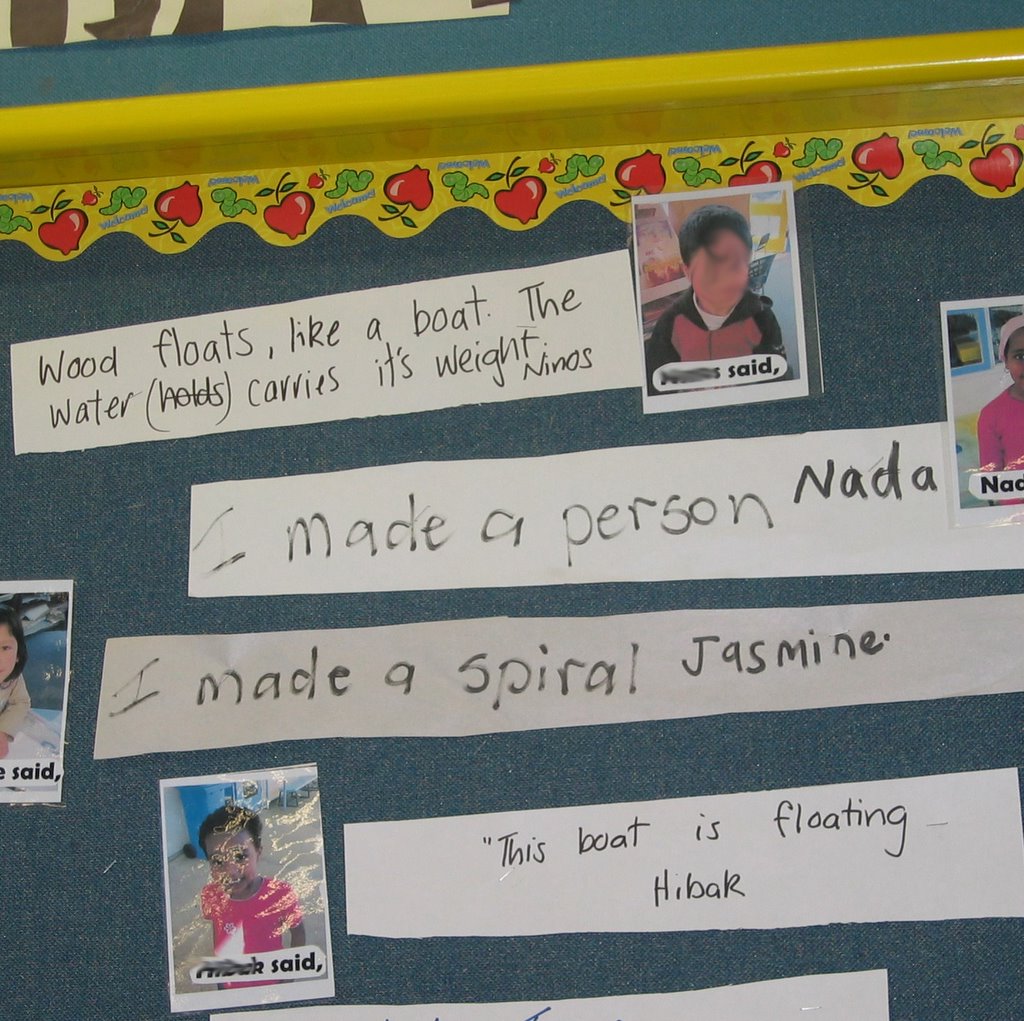
During the session, when teachers heard good examples of oral language, they wrote down what was said. This was then displayed on the wall next to the student's name and photo. At the end of the session these 'good talking' quotes were shared with the class. This was a highlight of the reflection time and very much enjoyed by the children.

Sunday, February 12, 2006

What is Discovery Time?
Discovery Time is a ninety minute, action packed, activity based programme similar to the 'Developmental' or 'Choosing Time' concept of the 1970's. Held once a week, it provides opportunities for teachers to meet the cognitive, social-emotional and physical needs of students through well planned, structured, activity based experiences.
It began two years ago as a collaborative project between the Junior Syndicate at Porirua East School and Resource Teachers: Learning & Behaviour (RTLB). Since then the concept has continued to grow and develop. It is now used in over thirty classrooms in the greater Wellington area (please add a comment if you have set it up in other parts of New Zealand, we'd love to hear from you).
It was initially designed to meet the needs of students who found the structured academic focus of junior classrooms a challenge. It soon became apparent that there were benefits for all students and for teachers as well. The programme is based on three key principles:
  • That students need opportunities not only for cognitive development, but also for social-emotional and physical development.
  • That students need to be actively involved in 'hands on' experiential learning.
  • That student directed learning increases motivation and success.

During Discovery Time, the children; experiment, problem solve, challenge themselves, practise new skills, explore new ideas, think creatively... the list is endless. At the end of the session they reflect on their experiences and share what they have learned.

For teachers, it's a time to step back from the 'teacher' role and become the facilitator, the questioner, the encourager, the helper...

Discovery Time is one of the highlights of the school week.

Monday, December 05, 2005

What teachers are saying about Discovery Time...

"It gives us a chance to stand back and observe, to get to
know the children and to build relationships with individuals."

"It allows children to take control of their own learning."

"It's a good time for social skill development, for sharing and getting on with others."

"It allows us to extend and expand the class programme."

"Children can consolidate learning and confirm ideas. They can reflect and verbalize what they have learned."

" You can structure the session to meet oral language needs."

"It gives teachers time to take a step back and let the kids go for it."

"It is easy to cater for different abilities - one activity can be taken on many levels."

"Provides hands on learning opportunities."

"A great platform for written language."

"It's fun - joining in with the kids takes some of the pressure off."

"Students get stuck in and involved - there are no behaviour problems."

"The unplanned things are often the 'wow' things when the best learning occurs."

Monday, November 28, 2005

"Play is the natural way in which children go about the business of learning. It enables them to integrate and consolidate a wealth of experiences that enhance their cognitive, physical, social and emotional development" (p128).

Fisher, J. (2002). Starting from the child: teaching and learning from 3 to 8. 2nd ED. UK: Open University Press.