Tuesday, August 08, 2006
Sunday, August 06, 2006
The revised curriculum (Draft for consultation) was released this week by the Ministry of Education.
Discovery Time enthusiasts will be delighted to see that it aligns very closely with the basic tenets of our programme. The section on effective pedagogies affirm everything we have been saying! Yeah!
We originally developed the programme around 'Curriculum Areas' and 'Essential Skills', hence the strong focus on these in the planning sheet, so we were very keen to see what the changes would be.
The Essential Skills has been replaced by the Key Competencies: managing self, relating to others, participating and contributing, thinking, using language symbols and texts. These work perfectly for Discovery Time - fantastic!
We are in the process of rewording parts of the planning sheet to reflect the curriculum changes and to incorporate some of the feedback we have had from teachers.
If you contact me I will send a copy as soon as it's ready.
A copy of the curriculum arrived in schools last week, so don't forget to hunt it down and have a look at it.
Thursday, July 27, 2006
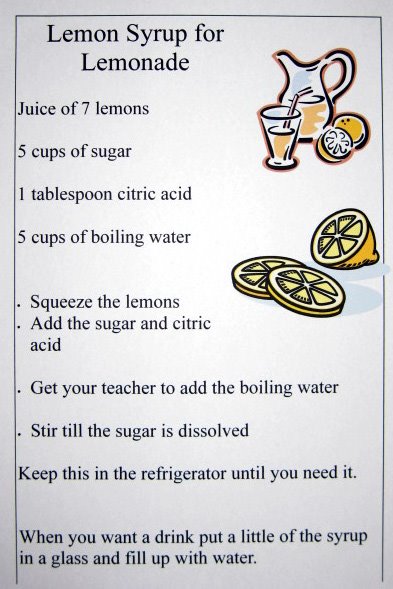
This is a great activity for Discovery Time and perfect for this time of the year when there are so many lemons around.

The recipe makes enough syrup for the whole class to have a drink.
It provides a perfect opportunity for encouraging participation / collaboration and oral language (essential skills / key competencies).
The activity can be extended by:
- Setting up a drink stall - with cash register and play money. Children design a sign and decide on a price.
- Setting up a cafe - children organise the table, waiting staff (with pad & pen), money, kitchen staff for washing up etc.
Sunday, July 16, 2006

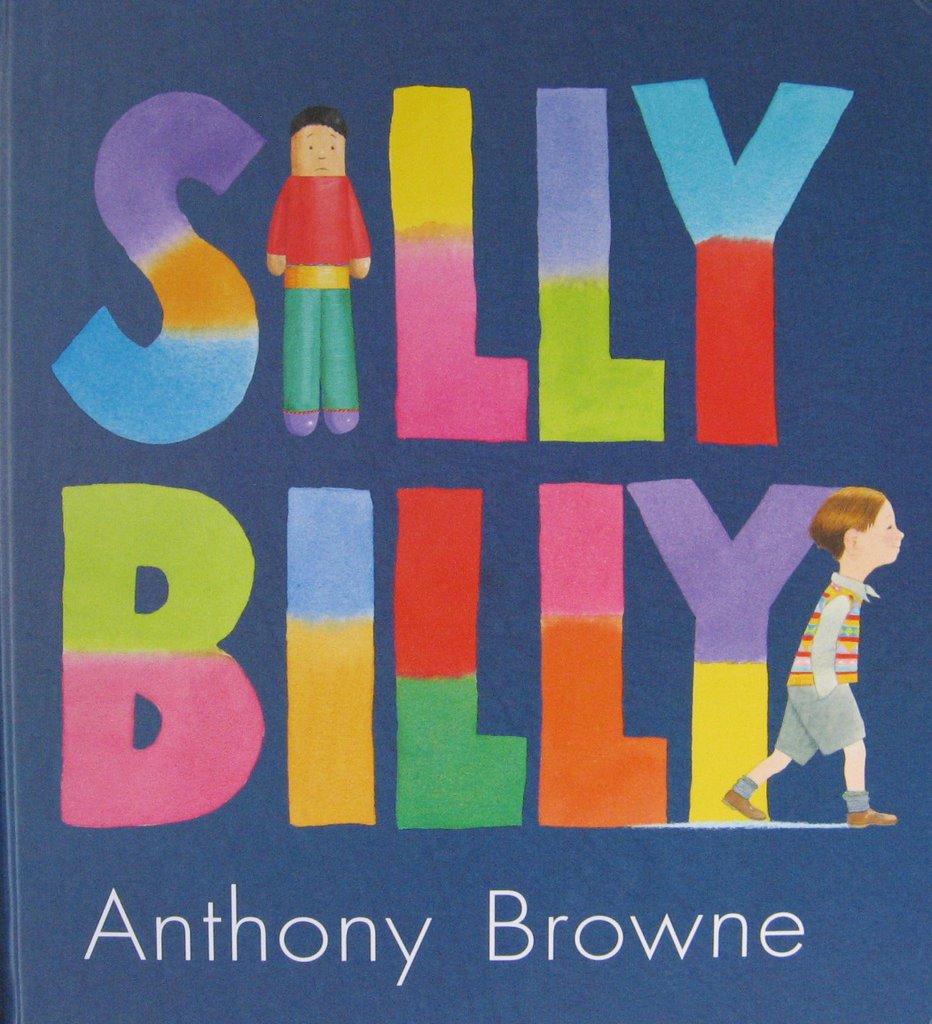
'Billy was a worrier - he worried about everything, until his Grandma introduced him to worry dolls...'
Here's a wonderful response to this story from a yr 1&2 class. The teacher read the story to the class and then included the activity in Discovery Time the next day. She set up a table with wooden pegs (from the $2 shop), PVA glue and scraps of fabric/wool and the children set to with very little adult assistance.
These are some of the worry dolls
they made.
Tuesday, June 20, 2006
The latest 'Starters & Strategies' magazine (http://www.teachingonline.org), dropped onto my desk this week, this is what they have to say about Matariki.
Tell students that Matariki, the name given to the Maori new year, refers to a cluster of stars that are seen just before dawn, slightly north of the easterly horizon during late may / early June. The celebration of Matariki begins when the first new moon appears after the star cluster becomes visible. This year it is 27th June.
- If the stars in the cluster are clear and bright, then it is thought that the year ahead will be warm and productive.
- If the stars in the cluster are hazy and shimmering, a cold winter is ahead and we must prepare for this.
The nearest star of Matariki is 440 light years away from earth. Light travels at just under 300,000 kilometres per second. Can students suggest a method of how to calculate this distance? Can they do it?
Here are some web sites that the magazine suggests:
Kites are a special part of Matariki celebrations so you may want to make kites during Discovery Time.
I've search a number of sites and these two seem to be the best. Be warned though, I haven't tried them... yet!!! I'll report back next week.
http://www.xs4all.nl/~pdj/birdkite.htm This gives good simple instructions for making a bird kite out of plastic.
http://www.aloha.net/~bigwind/20kidskites.html This is a very simple kite using paper and shish kabab sticks.
Make sure you hunt out 'Starters & Strategies' in your schools. there are lots of ideas for Matariki.
Thursday, June 08, 2006
When I set up this blog I thought that it would be interactive. That people would add information and ideas through the comments function. This hasn't happened!!!!!
So how about it!
Over the next few weeks some children will be following the World Cup, so how about letting us know how you are going to incorporate this into Discovery Time. Maybe developing soccer skills, designing jerseys for a New Zealand team or perhaps exploring food from Germany. I'm sure there are some good websites out there that children could explore too.
So how about sharing your ideas. Just click on the comment icon and leave an anonymous message (if you make it anonymous you don't need to log on or get involved in passwords). Give it a go, we'd love to hear from you.
Monday, May 29, 2006
Sunday, May 28, 2006
This is not a definitive list, just a selection that we have purchased for schools because we feel they provide great ideas for Discovery Time.
From Horowitz publishing
Hamburger
Let's make pancakes
Magic tricks
Making a picture
Making a torch
Making bread
Making butter
Making dips
Making music
Making spaghetti
Milk shake
Shadow puppets
The school news
Treasure hunt
From Nelson Price Milburn publishers
Bees in the garden
Dinosaur
Growing peas
Ladybird ladybird
Making a bird
Making a cat & mouse
Making a rabbit
Making a toy house
Making breakfast
Making lunch
Making party food
My noodle necklace
Our butterflies
Thursday, May 18, 2006
I visited a year one class at Windley School and saw an amazing Discovery Time with a focus on photography. It had began with the teacher taking photos of each student and then progressed into:
making their own cameras
constructing photo frames
setting up a photo shop
There were of course other DT activities going on at the same time but these three activities provided a focus.

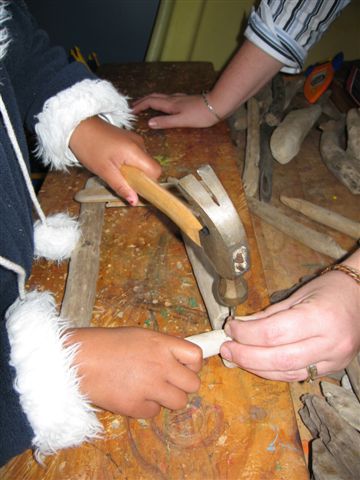
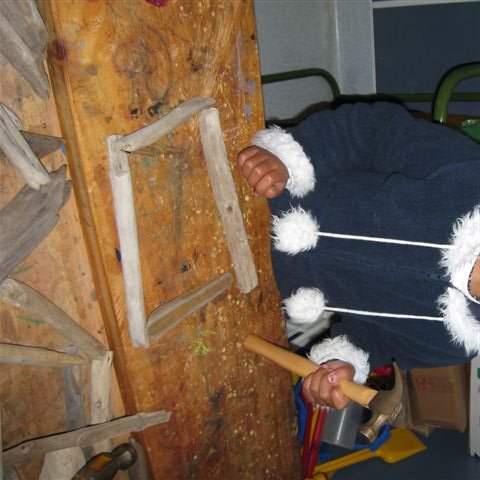
The photo frames - made out of driftwood involved some good carpentry skills and the children soon discovered that some pieces were softer than others - lots of great vocabulary extension work going on around the table.
These activities continued over several Friday sessions. They were hugely successful, yet quite simple to organise.
Thursday, May 11, 2006
Dig in
Elastics
Fun with shadows
Jacks
Let's make music
Let's Play
Magnets
Make a house
Make a mobile
Making a milkshake
Making blueberry muffins
Marbles
Paper planes
Skipping games
String games
What is it?
Wednesday, May 03, 2006
Michael Fielding is from the University of Sussex in the UK and is Director for Innovation Education .
He strongly believes that we should be involving students in their own learning and that listening to and valuing childrens' voices has to be a priority for classes of the future. He says that in order to do this teachers need to take on a facilitating role!!!!
So, all you teachers out there doing Discovery Time you are right on target!
This interview is 18 minutes long and can be heard on www.radionzco.nz
Bring up the web page, go to live audio streaming, then nine to noon, select Tues, 02 May.
If you left click you can listen to it
If you right click you can save it with - save target as (and then listen to it later)
These are their thoughts on the role of the teacher in Discovery Time
A facilitator
Helping children extend themselves
Helping children take responsibility for their own learning.
Setting up situations where learning can happen
Setting a safe secure environment so that children feel they can take risks
Setting rules and boundaries for listening & speaking, so that children feel safe.
Organising the room so that children can access equipment and work independently
A prompter of ideas – asking open ended questions
What might happen if…?
Can you try that another way?
Where do we go next?
Why did you do it like that?
Tell me about it?
What are you going to need next?
How do you think it will work?
What do you think might happen if…?
I’d like to do that. What do I have to do?
An observer
Notice successes
Notice strengths and weaknesses
Notice different personalities
Notice different interactions
Gather information for further planning
Gather information for meeting individual specific needs
A role model
Model specific behaviours that you want to target – looking after equipment, sharing, taking turns etc
A participator
Joining in as one of the kids rather than as the teacher
A listener
Taking time to really hear what children are saying
Thank you to Jamie, Shona, Marion, Bev, Kylie and Vanessa for this valuable contribution.
Friday, April 28, 2006
Thursday, April 27, 2006
Higher order thinking can be encouraged through:
- An endless range of great frameworks (Blooms, Habits of Mind, 6 Hats).
- The use of HOT questions
- Graphic organisers
- contextual thinking experiences (cooperative learning structures are great)
The HOT questions really caught my attention
examples: Why are at least 90% pf websites around the world written in English?
How do wings work?
Which toy would choose you?
HOT questions should 'stretch' the thinking and present a cognitive challenge.
We can think of HOT questions for every topic we might be studying - children have fun thinking of them too.
We should be using them hundreds of times a week!
So what has all this got to do with Discovery Time?
I believe strongly, that it is the quality of teachers' thinking and questioning that determines the quality of a Discovery Time session.
We need to be using 'open ended' and 'HOT' questions to encourage higher order thinking during Discovery Time.
Check out Tony Ryan's website www.tonyryan.com.au
Tuesday, March 21, 2006
“Children learn through collaboration with adults and peers, through guided participation and observation of others, as well as through individual exploration and reflection” (Te Whariki)
Ministry of Education (1996). Te Whariki: He Whariki Matauranga mo nga Mokopuna o Aotearoa (Early Childhood Curriculum). Wellington: Learning Media.
“In New Zealand, early childhood is defined as the period of education from birth to approximately 5-6 years of age – there are good arguments, based on research, to extend this to 8 years.” (Farquar 2003, p1).
Farquhar, S. (2003). Quality Teaching Early Foundations: Best Evidence Synthesis. Wellington: Ministry of Education.
“By year one, there was very little time for play as teachers struggled with content overload from the policy requirements. Just as children become more skilled in their play, opportunities for play are restricted. Policy-makers assume that young children need more challenging work, whereas research shows that they also need more challenging play” (Wood & Attfield, 2005, p153).
Wood, J. & Attfield, J. (2005) Play, Learning and the Early Childhood Curriculum. (2nd. Ed.). London: Paul Chapman Publishing
Wednesday, March 01, 2006
Have you spotted on The UK Guardian Education page research from Michael Sayer claiming that children are not making the predicted gains from all the input of literacy and numeracy funded programmes.
He quotes "........I would suggest that the most likely reasons are the lack of experiental play in primary schools, and the growth of a video-game, TV culture. Both take away the kind of hands - on play that allows kids to experience how the world works in practice and to make informed judgements about abstract concepts."
Check out article January 24 The Guardian.
Monday, February 27, 2006
Tuesday, February 21, 2006
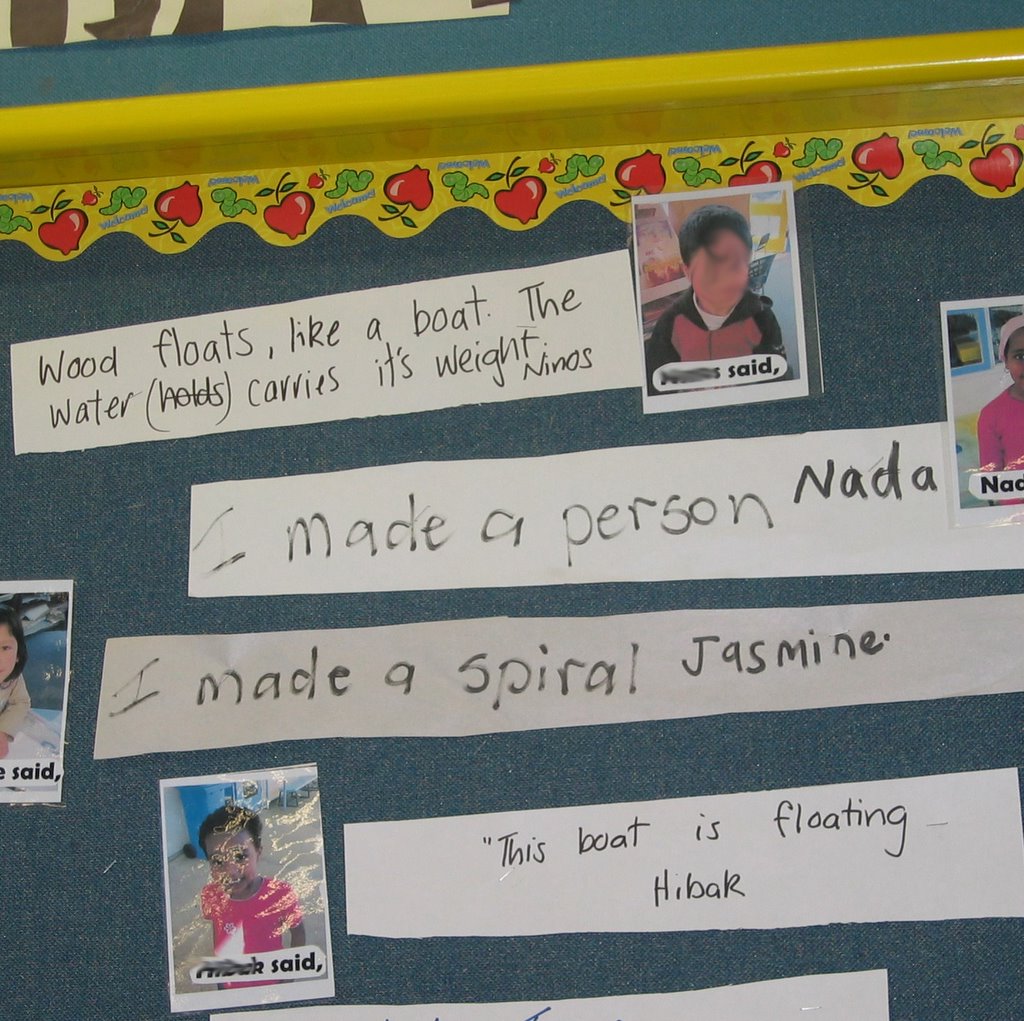
At the end of last year Gay and I visited a school in South Wellington. Brigid (class teacher) along with Angela & Warren (RTLB) have set up Discovery Time to target the oral language needs of their year 1 & 2 students.During the session, when teachers heard good examples of oral language, they wrote down what was said. This was then displayed on the wall next to the student's name and photo. At the end of the session these 'good talking' quotes were shared with the class. This was a highlight of the reflection time and very much enjoyed by the children.
Sunday, February 12, 2006
- That students need opportunities not only for cognitive development, but also for social-emotional and physical development.
- That students need to be actively involved in 'hands on' experiential learning.
- That student directed learning increases motivation and success.
During Discovery Time, the children; experiment, problem solve, challenge themselves, practise new skills, explore new ideas, think creatively... the list is endless. At the end of the session they reflect on their experiences and share what they have learned.
For teachers, it's a time to step back from the 'teacher' role and become the facilitator, the questioner, the encourager, the helper...
Discovery Time is one of the highlights of the school week.
Monday, December 05, 2005
"It gives us a chance to stand back and observe, to get to
know the children and to build relationships with individuals.""It allows children to take control of their own learning."
"It's a good time for social skill development, for sharing and getting on with others."
"It allows us to extend and expand the class programme."
"Children can consolidate learning and confirm ideas. They can reflect and verbalize what they have learned."
" You can structure the session to meet oral language needs."
"It gives teachers time to take a step back and let the kids go for it."
"It is easy to cater for different abilities - one activity can be taken on many levels."
"Provides hands on learning opportunities."
"A great platform for written language."
"It's fun - joining in with the kids takes some of the pressure off."
"Students get stuck in and involved - there are no behaviour problems."
"The unplanned things are often the 'wow' things when the best learning occurs."
Monday, November 28, 2005
Fisher, J. (2002). Starting from the child: teaching and learning from 3 to 8. 2nd ED. UK: Open University Press.